
Hands-on DevSecOps Training Builds Secure Cloud-Native Expertise
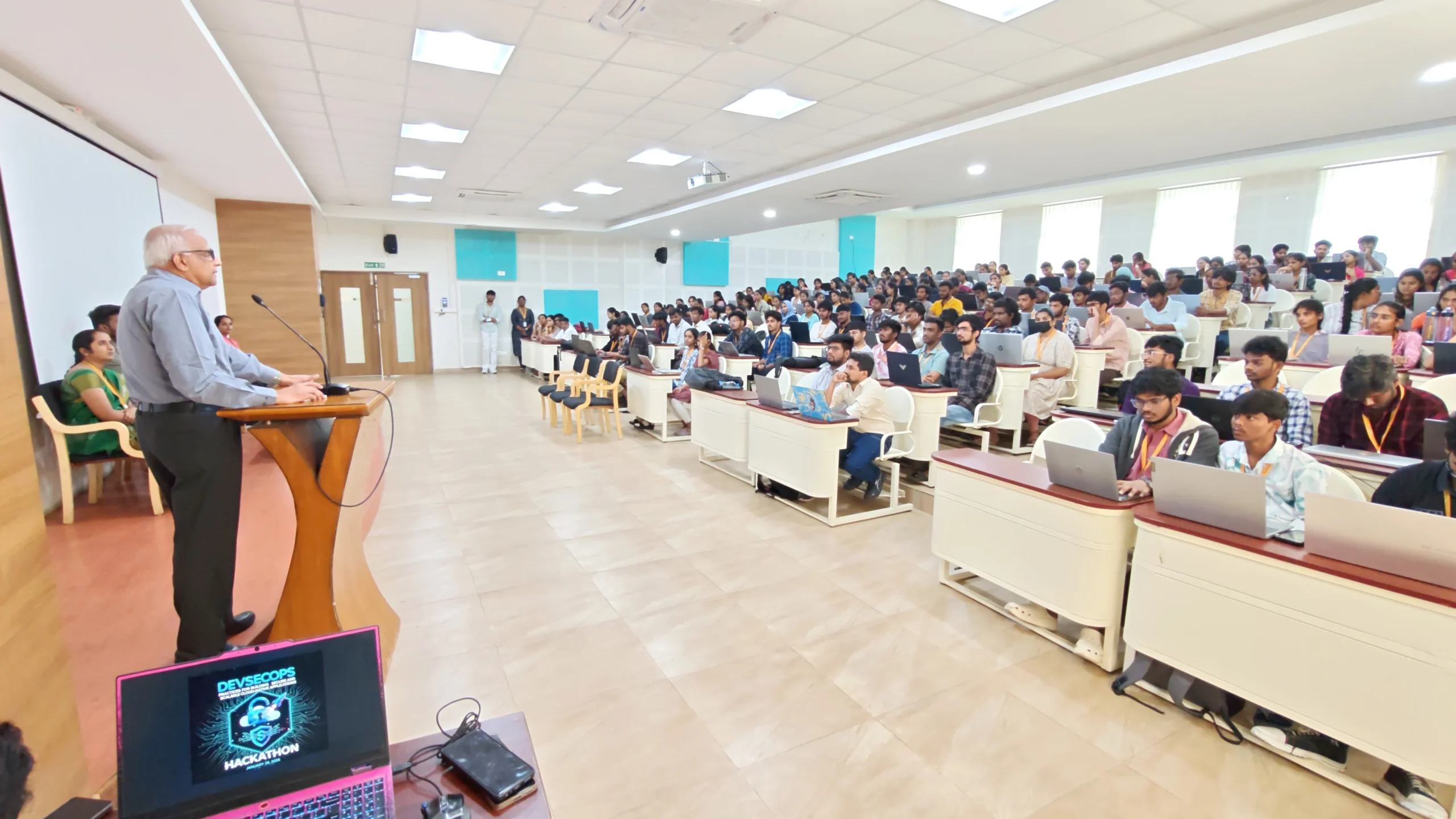
The School of Technology, The Apollo University, successfully organized a Three-Day Workshop and Hackathon on “DevSecOps Practices for Building Secure and Scalable Cloud-Native Applications” from 29th January to 31st January 2026, with the objective of equipping students with industry-relevant skills in secure software development and modern cloud-native practices. The programme was designed for undergraduate students from Computer Science and Engineering (CSE), Artificial Intelligence & Machine Learning (AIML), Artificial Intelligence & Data Science (AIDS), Cybersecurity, and Software Engineering streams, addressing the growing industry demand for professionals skilled in DevSecOps and secure application deployment.
The workshop was formally inaugurated by the Hon’ble Vice Chancellor, Dr. H. Vinod Bhat, who graced the occasion as the Chief Guest. In his address, Dr. Vinod Bhat emphasized the critical importance of integrating security into the software development lifecycle from the very beginning, and how it has become a cornerstone of modern, reliable, and scalable digital systems. He underlined the growing demand for smart professionals who possess not only technical expertise but also an ethical and security-conscious mindset. The Vice Chancellor encouraged students to actively power up such hands-on platforms to learn real-world industry practices, stating that experiential and challenge-based learning initiatives like this workshop are essential in shaping competent engineers capable of contributing meaningfully to the nation’s digital and technological growth.
The workshop commenced with in-depth sessions on DevSecOps fundamentals, emphasizing the importance of integrating security at every stage of the software development lifecycle. Participants were introduced to core concepts such as continuous integration and continuous deployment (CI/CD) pipelines, containerization, secure coding practices, and proactive vulnerability management. The sessions provided a strong conceptual foundation, enabling students to understand how development, security, and operations work together to build resilient and scalable cloud-native systems.
The technical depth and practical orientation of the programme were further strengthened by the sessions delivered by the Resource Person, Mr. Kandela Melky Vignan, CTO, DevOps & Cloud Trainer, and NSDC-certified expert with over nine years of industry experience. In his address and hands-on mentoring, Mr. Vignan provided valuable insights into real-world DevSecOps implementation, drawing from his extensive experience in training more than 10,000 candidates. He guided participants through contemporary DevSecOps workflows, secure CI/CD pipeline design, container security, vulnerability scanning, and remediation strategies using industry-standard tools. His interactive teaching style, practical demonstrations, and continuous engagement with student teams during labs and the hackathon enabled participants to gain a clear understanding of how secure and scalable cloud-native applications are built in professional environments, making his contribution a defining highlight of the three-day programme.
A major highlight of the programme was its hands-on, tool-oriented approach, which allowed participants to gain practical exposure to widely used industry tools. Through guided laboratory sessions, students worked with Git for version control, Jenkins for CI/CD automation, Docker for containerization, SonarQube for static code analysis, and Trivy for vulnerability scanning. These labs enabled students to design, deploy, and secure CI/CD pipelines while identifying and mitigating potential security risks, thereby translating theoretical knowledge into real-world application.
On the final day, a Hackathon was conducted to assess participants’ practical understanding, teamwork, and problem-solving abilities. Students worked in teams to analyze CI/CD pipelines, identify security loopholes, and implement appropriate remediation strategies. The hackathon fostered collaboration, critical thinking, and hands-on experimentation, closely simulating real-world DevSecOps challenges faced in industry environments. A total of 161 students participated in the event, including 160 internal students and one external participant, reflecting strong interest and engagement.
At the conclusion of the hackathon, three teams, each comprising four members, emerged as winners. The winning teams represented II Year B.Tech students from Cybersecurity, AIML, AIDS, and CSE programmes, showcasing strong technical competence and effective teamwork. Their performance highlighted the success of the workshop in enhancing practical skills and reinforcing secure development practices among students.
Overall, the three-day programme successfully bridged the gap between academic learning and industry expectations by providing immersive, challenge-based learning experiences. The workshop and hackathon was conducted and coordinated with the lead of the faculty coordinators, Dr Manju A. B., Deputy Controller of Examinations and Assistant Professor, SoT and Dr Sangeetha S, Assistant Professor, SoT. The event significantly enhanced students’ understanding of DevSecOps culture, secure CI/CD pipeline implementation, vulnerability scanning, and remediation techniques. Participants gained increased confidence in applying DevSecOps practices to real-world scenarios, strengthening their readiness for careers in cloud computing, DevOps, and cybersecurity.