
COURSE OVERVIEW
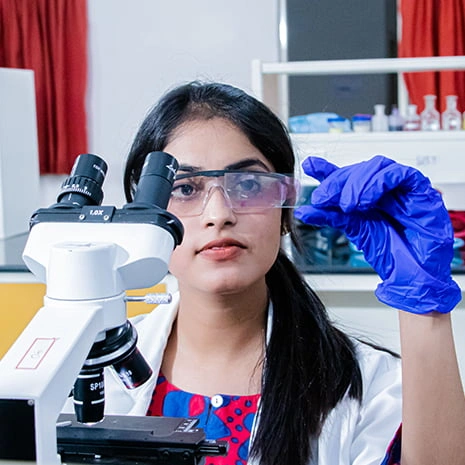
The B.Sc. Genetics and Molecular Biology programme at The Apollo University is designed in response to the increasing demand for trained manpower in the areas of Cancer Biology, Genetic Engineering, and Biotechnology. The committee of faculty and experts from the Apollo Hospitals Group proposed this programme to explore the study of diseases in living organisms, covering everything from the interactions of animals in their environment to how genes are expressed and related to various diseases. The programme is broad-based, providing a good insight into modern biology and an important component of hands-on training for the students. Thus, by nature, it will be an interdisciplinary programme. Molecular Biology is the applied domain of life and natural sciences, used for diagnosis, prevention and treatment of human diseases. The various streams of biomedical science include Molecular Genetics, Pathology, Biochemistry, Molecular and Cell Biology, Bioinformatics, Immunology, Stem Cells and Tissue Engineering, Epidemiology, and Molecular Therapeutics. At The Apollo University, we have skilled and experienced faculty to impart training in various tools and techniques of Molecular Biotechnology. Moreover, we facilitate our students with the latest technologies during the lab sessions to ensure a hands-on experience, which in turn helps them become industry-ready. The curriculum is designed to provide project-based learning, where students work on projects as part of their studies. On 2nd February 2023, the Visitor Education Programme Agreement (VEPA) was signed between The Apollo University and Brigham and Women’s Hospital, Inc., 75 Francis Street, Boston, MA 02115, USA. In addition to improving the students’ research skills, the university has signed a memorandum of understanding (MoU) with the University of Hyderabad, India and Aurobindo Pharma, India, which provide training to the students of B.Sc. Genetics and Molecular Biology.
PROGRAMME OBJECTIVES
- To produce graduates who understand fundamental genetic principles and apply that understanding to analyse and manipulate traits in living organisms.
- To summarise the background, methodology, results and conclusions of a set of experiments, as published in a single or multiple related scientific papers, and lead classroom discussions on them
- To understand the importance and applications of scientific thinking in the fields of health and biomedicine
- To use and apply new tools and techniques of Molecular medicine to solve healthcare industry problems.
- To engage the students in industry-based practice based on student interest and field demand
PROGRAMME HIGHLIGHTS

Programme Curriculum
- I Semester + -
3 Week Induction Programme Course Code Course Name Periods per week Credits Hours per week L T P BITT1501 Cell Biology and Genetics 3 1 0 4 4 BITT1502 Biochemistry 3 1 0 4 4 BITT1503 Data Science 3 1 0 4 4 TAUT1101 University Core – 1 Communicative English 3 0 0 3 3 TAUT1201 University Elective – 1 3 0 0 3 3 BITL1501 Data Science Lab 0 0 4 2 4 BITL1502 Biochemistry lab 0 0 4 2 4 — Soft Skills 0 0 0 0 1 — Mentoring 0 0 0 0 1 — Technical Seminar 0 0 0 0 1 — Library 0 0 0 0 1 — Physical Activity 0 0 0 0 2 — Extra-curricular activities 0 0 0 0 2 — Co-curricular activity 0 0 0 0 1 — Self-Learning 0 0 0 0 1 TOTAL 15 3 8 22 36
- II Semester + -
3 Week Induction Programme Course Code Course Name Periods per week Credits Hours per week L T P BITT1504 Molecular Biology and Genetic Engineering 3 1 0 4 4 BITT1505 Microbiology 3 1 0 4 4 BITT1506 Bioanalytical Techniques 3 1 0 4 4 TAUT1102 University Core – 2 Environmental Studies 3 0 0 3 3 TAUT1202 University Elective – 2 3 0 0 3 3 BITL1503 Molecular Biology and Genetic Engineering Lab 0 0 3 1.5 3 BITL1504 Microbiology Lab 0 0 3 1.5 3 — Soft Skills 0 0 0 0 1 — Mentoring 0 0 0 0 1 — Technical Seminar 0 0 0 0 1 — Library 0 0 0 0 1 — Physical Activity 0 0 0 0 2 — Extra-curricular activities 0 0 0 0 2 — Co-curricular activity 0 0 0 0 1 — Self-Learning 0 0 0 0 1 TOTAL 15 3 8 22 36
- III Semester + -
Course Code Course Name Periods per week Credits Hours per week L T P BITT2507 Immunology 3 1 0 4 4 BITT2508 Plant Biotechnology 3 1 0 4 4 BITT2509 Enzyme Technology 3 1 0 4 4 BITT2510 Nanobiotechnology 3 1 0 4 4 TAUT2101 University Core – 3 Health and Wellness 3 0 0 3 3 TAUT2201 University Elective – 3 3 0 0 3 3 BITL2503 Immunology Lab 0 0 4 2 4 BITL2504 Enzyme Technology Lab 0 0 4 2 4 — Technical Seminar 0 0 0 0 1 — Library 0 0 0 0 1 — Physical Activity 0 0 0 0 2 — Extra-curricular activities 0 0 0 0 2 TOTAL 18 4 8 26 36
- IV Semester + -
Course Code Course Name Periods per week Number of Hours L T P C BITT2511 Animal Cell Culture and
Techniques3 1 0 4 4 BITT2512 Industrial Biotechnology 3 1 0 4 4 BITT2513 Bioinformatics 3 1 0 4 4 BITT2514 Biosafety and Ethics 3 1 0 4 4 BITT2601 Program Elective – 1 3 0 0 3 3 BITT2602 Program Elective – 2 3 0 0 3 3 BITL2505 Bioinformatics Lab 0 0 4 2 4 BITL2506 Industrial Biotechnology Lab 0 0 4 2 4 Technical Seminar 0 0 0 0 1 Library 0 0 0 0 1 Physical Activity 0 0 0 0 2 Extra-curricular activities 0 0 0 0 2 TOTAL 18 4 8 26 36
- V Semester + -
Course Code Course Name Periods per week Number of Hours L T P C BITT3515 Protein Engineering 3 1 0 4 4 BITT3516 Food Biotechnology 3 1 0 4 4 BITT3517 Medical and Pharmaceutical Biotechnology 3 1 0 4 4 BITT3518 Principles of Bioprocess Engineering 3 0 0 3 3 BITT3603 Program Elective – 3 3 0 0 3 3 BITT3604 Program Elective – 4 3 0 0 3 3 BITP3501 Mini project 0 0 6 3 6 Technical Seminar 0 0 0 0 3 Library 0 0 0 0 2 Physical Activity 0 0 0 0 2 Extra-curricular
activities0 0 0 0 2 TOTAL 18 3 12 24 36
- VI Semester + -
Course Code Course Name Periods per week Number of Hours L T P C BITT3605 MOOCs Course – 1 2 0 0 2 2 BITT3606 MOOCs Course – 2 2 0 0 2 2 BITP3502 Major-project 0 0 32 16 32 TOTAL 4 0 32 20 36
PROGRAMME FEE AND SCHOLARSHIPS
| One-Time Fee | Admission Fee | ₹ 7,000 |
| 1st Year | Tuition Fee + Annual Recurring Fee | ₹ 88,000 + ₹ 13,000 |
| 2nd Year | Tuition Fee + Annual Recurring Fee | ₹ 88,000 + ₹ 13,000 |
| 3rd Year | Tuition Fee + Annual Recurring Fee | ₹ 88,000 + ₹ 13,000 |
| Total Course Fee | ₹ 3,10,000 |
Scholarship is available for eligible students
Eligibility
Passed with at least 45% (40% in case the candidates belong to reserved category) marks with Botany, Zoology, Physics and Chemistry or Inter vocational with Bridge course of Biological and Physical Sciences (or) APOSS with Biological Sciences and Physical Sciences from a recognized board or other equivalent board or Intermediate and attain 17 Years as on 31st December of Calendar Year.
EMPLOYABILITY AREAS
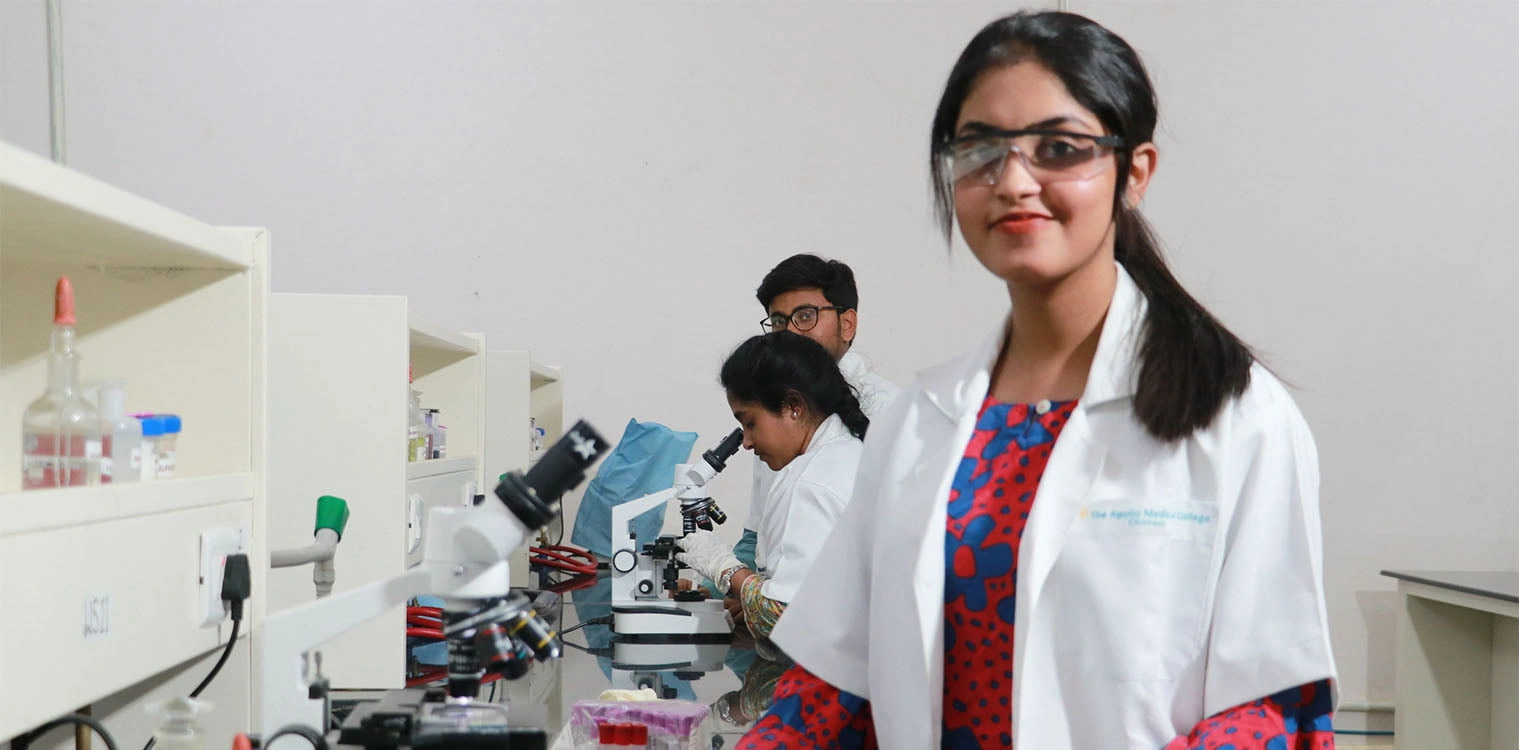
The Genetics and Molecular Biology graduates can explore the employment opportunities in various public and private sectors. They mostly acquire the following positions:
- Clinical Scientist
- Biomedical Scientist
- Lab Manager
- Biomedical Engineer
- Clinical Researcher
- Clinical Database Manager
- Clinical Research Coordinator
FAQs
-
Who is eligible for BSc Molecular Biology?
+ -Students with at least 45% marks in class 12 with subjects including (40% for reserved categories) in Botany, Zoology, Physics and Chemistry are eligible for the B.Sc. Molecular Biology programme.
-
What is the duration for BSc Molecular Biology?
+ -The B.Sc. Genetics and Molecular Biology is a 3-year degree programme.
-
What is the scope of Molecular Biology?
+ -Graduates can work as clinical scientists, biomedical engineers, lab managers, or pursue higher studies like M.Sc. or Ph.D. in related fields.
-
Is there a demand for molecular biology?
+ -Yes. Molecular biology professionals are in high demand in research labs, healthcare, pharmaceuticals, biotechnology and genetic engineering sectors.
-
What are the subjects in BSc Genetics?
+ -Key subjects include Molecular Genetics, Pathology, Biochemistry, Molecular and Cell Biology, Bioinformatics, Immunology, Stem Cells and Tissue Engineering, Epidemiology and Molecular Therapeutics.