Discovering Human Origins with DNA: Padma Shri Thangaraj Delivers Special Lecture at The Apollo University
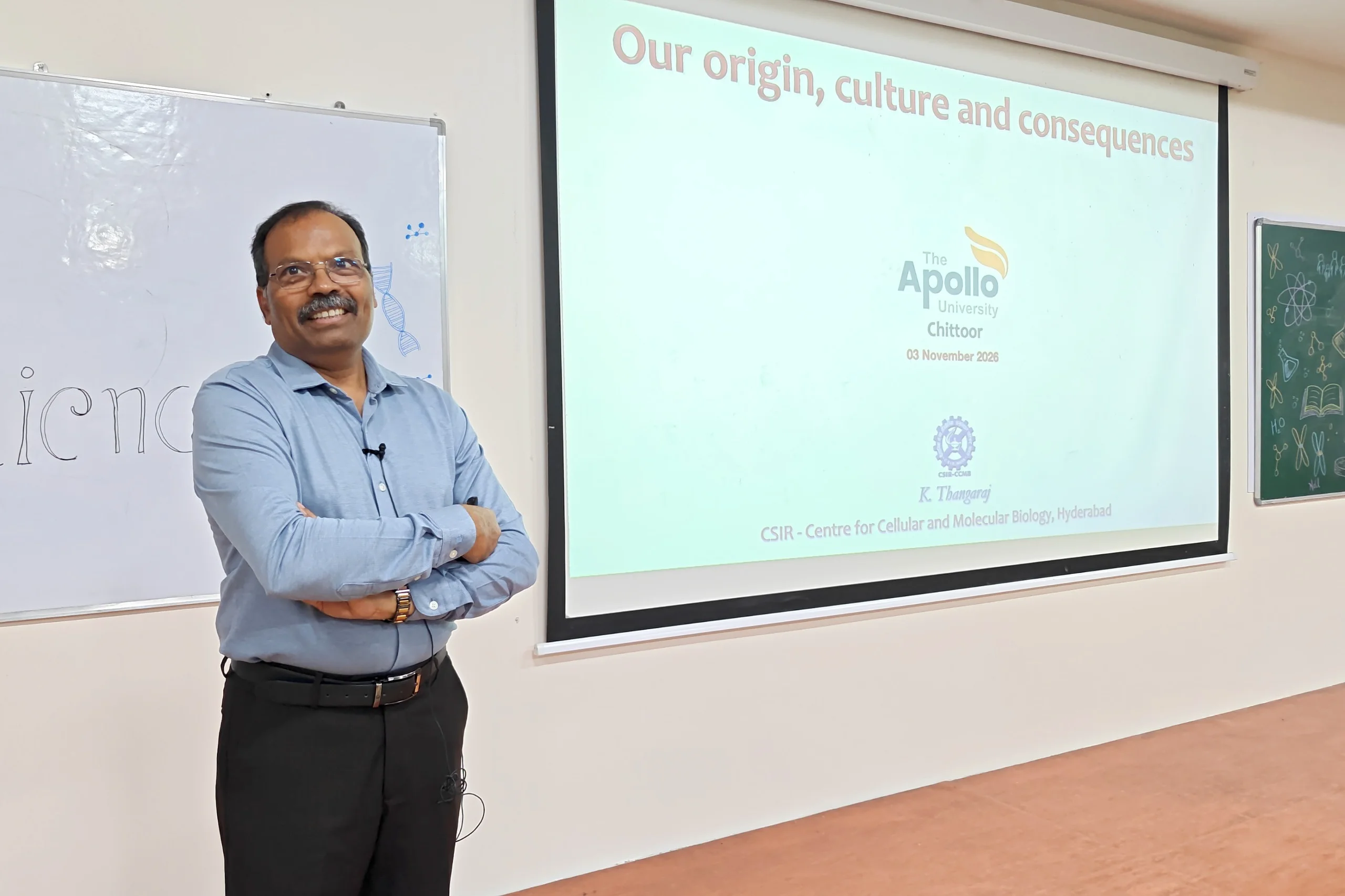
The Apollo University organised a special academic lecture titled “Our Origins, Culture and Evolution” by renowned genetic scientist and Padma Shri awardee Professor Kumarasamy Thangaraj, as part of its efforts to promote research awareness and interdisciplinary learning among students and faculty. The lecture was organised by the Department of Biomedical Sciences, School of Health Sciences, and explored how genetic research and DNA analysis provide valuable insights into human origins, migration patterns, ancestry, culture and evolutionary history. Professor Thangaraj, who has been conducting research in human genetics for nearly three decades, shared findings from his extensive studies on the genetic diversity of Indian populations and the evolution of modern humans.
During the lecture, Professor Thangaraj explained that his research on tribal communities of the Andaman Islands has contributed significantly to understanding human evolutionary history. His team's findings identified these communities as descendants of some of the earliest modern humans who migrated from Africa through the southern coastal route approximately 65,000 years ago. This research, published in the Journal of Human Genetics in 2005, provided important insights into the early migration patterns of modern humans.
He further discussed the genetic composition of Indian populations, explaining that the ancestors of Indians have been broadly identified through two major genetic groups, with significant genetic mixing occurring between populations of different genetic backgrounds approximately 2,000 to 4,000 years ago. He also highlighted research indicating that the ancestors of the Roma community in Europe migrated from India approximately 1,400 years ago. These findings illustrated the interconnectedness of human populations and demonstrated how genetic evidence can help trace shared ancestry across geographical and cultural boundaries.
The lecture also highlighted major national research initiatives, including the Genome India Project, involving 20 research institutions working towards understanding the genetic diversity of India's population. Professor Thangaraj also discussed a national-level research programme involving 16 institutions focused on children affected by rare genetic diseases. He noted that more than 250 research scholars had been trained through these initiatives, reflecting the growing scope of genetic research and capacity building in India.
Professor Thangaraj, a CSIR Bhatnagar Fellow at the CSIR-Centre for Cellular and Molecular Biology (CCMB), Hyderabad, emphasised that despite differences in geographical origins, cultures and traditions, genetic research reveals a shared human heritage. His presentation offered students and researchers valuable perspectives on the application of genetics in understanding human evolution, population history, and migration and disease research. The programme was attended by Mr. Anil Kumar S.,Registrar, The Apollo University; Dr. Ramya Ramakrishnan, Dean, AIMSR; Professor Ramesh S. Ve, Dean, School of Health Sciences; Dr. Satyanarayana, Head, Department of Biomedical Sciences; and Dr. M. K. Kanakavalli, Senior Technical Officer, CSIR-CCMB, along with faculty members, researchers and students. The special lecture provided an enriching academic platform for understanding the role of genetics in reconstructing human history and addressing contemporary scientific challenges. It also encouraged students to develop a deeper interest in biomedical research, genetic diversity and interdisciplinary scientific exploration.