

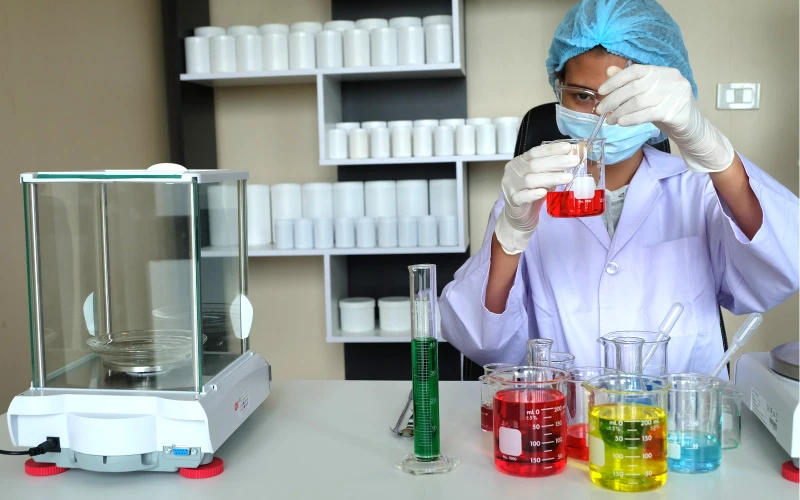
As per the Bureau of Labor Statistics report, around 22,600 positions for clinical laboratory technologists and technicians are expected to open each year, on average, over the next decade. The escalating demand for lab technicians stems from the expanding healthcare, pharmaceutical, research, and diagnostics sectors. Their versatility extends to roles in pathology labs, urology labs, blood banks, research facilities, and hospitals, reflecting the diverse opportunities available within this field.
There are several types of lab technician courses after completing 12th that serve as the gateway to the fascinating realm of lab sciences. Through these courses, students unravel the mysteries of biology, chemistry, and healthcare diagnostics, gaining practical skills that form the backbone of modern medical research and diagnosis. These courses are a pathway not just to a rewarding career but to a profound understanding of the sciences that shape our world.
Determining the “best” lab technician course after 12th can depend on various factors, including your career goals, interests, and the credibility of the institution offering the program. However, some well-regarded lab technician courses after completing 12th grade include:
| Serial No. | Programme Name | Duration | Eligibility |
| 1. | Diploma in Medical Laboratory Technology- DMLT | 2 years | +2 with PCB and marks between 40 and 50% aggregate range |
| 2. | Bachelor of Science in Medical Laboratory Technology aka B.Sc. MLT | 3 years + 1 year internship | +2 with Physics, Chemistry & Biology as compulsory subjects
Also, a minimum of 50% marks |
| 3. | Associate Degree in Clinical Laboratory Science | 2 years / up to 3 years for clinical preparedness | High school completion; typically requires science background |
| 4. | Certificate Programs in Lab Technology | 6 months to 2 years | +2 in science stream OR 10th standard with minimum 2 years of work experience in science laboratories |
| 5. | BSc Clinical Laboratory Technology | 3 years + 1 year internship | +2 with Physics, Chemistry & Biology with marks above 50% |
| 6. | BSc ECG and Cardiovascular Technology | 3 years or 2+1 years theory and internship | +2 with Physics, Chemistry & Biology and minimum 50% marks |
| 7. | BSc Medical Imaging Technology | 3 years + 1 year internship | +2 with PCMB subjects with minimum 50% marks |
| 8. | BSc X-Ray Technology / Radiology & Imaging Technology | 3 years / 3-4 years with internship | +2 with Physics, Chemistry & Biology with minimum 50% marks |
When choosing a course, consider factors such as accreditation, curriculum, hands-on training opportunities, faculty expertise, and potential career prospects upon completion. Researching and comparing these aspects among different institutions offering lab technician courses can help you find the one that aligns best with your career aspirations.
Here’s a fee-table matching the list of courses mentioned above-
| Serial No. | Course | Fees |
| 1. | Bachelor of Science in Medical Laboratory Technology (B.Sc. MLT / Medical Lab Technology) | ₹ 1,00,000 – ₹1,75,000 per year |
| 2. | BSc Medical Imaging / Imaging Technology (approx for BSc X-Ray / Radiology & Imaging Tech) | ₹ 1.40 lakhs per year |
| 3. | Diploma in Medical Laboratory Technology (DMLT) | ₹ 30,000 – ₹1,50,000 per year (private colleges) |
| 4. | Associate Degree in Clinical Laboratory Science | ₹ 10,000 – ₹50,000 |
| 5. | Certificate Programs in Lab Technology | ₹ 10,000 – ₹50,000 |
| 6. | BSc Clinical Laboratory Technology | ₹ 1,00,000 – ₹1,75,000 per year |
| 7. | BSc ECG and Cardiovascular Technology | 20,000 – ₹1,50,000 (varies widely with type, duration and institution) |
| 8. | BSc X-Ray Technology / Radiology & Imaging Technology | ₹ 80,000 – ₹2,00,000 per year in private institutions |
A Lab Technician or Medical Laboratory Technology (MLT) course equips students with a blend of technical expertise, analytical thinking and professional competencies essential for modern diagnostic and research environments. A few of these skills are-
After completing a lab technician course after 12th, graduates can explore various job roles in the healthcare sector, such as:
| Job Role / Designation | Approximate Annual Salary in India (Fresh to Mid-level) |
| Medical Lab Technician | ₹ 2.5 – 6.5 LPA |
| Clinical Laboratory Technician | ₹ 3.0 – 5.0 LPA |
| Lab Manager | ₹ 4.5 – 10.0 LPA (can be higher with large hospitals/labs) |
| Research Associate (Lab / R&D) | ₹ 4.6 – 10.0 LPA |
| Quality Control / Quality Assurance Technician | ₹ 5.0 – 8.0 LPA |
| Blood Bank / Transfusion-Lab Technician | ₹ 3.0 – 6.0 LPA |
| Microbiologist / Lab-based Biologist | ₹ 2.5 – 6.5 LPA |
| Lab Services Analyst | ₹ 4 – 8 LPA |
| Educator / Instructor (for Lab-courses / Training Institutes / Colleges) | ₹ 4 – 9 LPA (depending on institute, seniority, academic rank) |
| Pharmaceutical Industry Roles (QC, R&D, Production Labs, etc.) | ₹ 3 – 7 LPA (entry-level) — potentially more with skills / specialization / seniority |
These roles illustrate the diverse career paths available to graduates, allowing them to contribute significantly to the healthcare and medical research fields.
Also Read- Career After BSc MLT – Jobs & Higher Study Options
The Bachelor of Science in Medical Laboratory Technology at The Apollo University offered by the School of Health Science spans four years of undergraduate study, organised into six semesters alongside a year-long internship. This comprehensive program equips students with both theoretical and practical expertise in diagnosing, treating, and preventing a wide array of diseases and health conditions using clinical laboratory tests.
Upon finishing the BSc MLT program, students will achieve the following:
Here are the key highlights of the Medical Lab Technology program at TAU:
Studying BSc MLT at The Apollo University opens the doors to a dynamic world of healthcare innovation and expertise. With a rigorous curriculum and hands-on training, this programme equips you to become a skilled professional in the realm of medical laboratory technology. Join The Apollo University to not just learn, but to lead. Take the first step towards a rewarding career in healthcare, enroll in the BSc MLT programme and get on a journey of discovery, impact, and excellence. Your future in healthcare begins here at The Apollo University.
The length of a Lab Technician course after the 12th can differ based on the educational level and the particular program chosen. Typically, a Diploma course in Medical Laboratory Technology (DMLT) spans from 6 months to 2 years, whereas a Bachelor’s degree program may take 3-4 years to complete.
Having a background in the science stream with a focus on physics, chemistry, mathematics, or biology is the main prerequisite for stepping into the role of a lab technician. After completing 10+2, you have the option to enrol in either a diploma course or a degree program in lab technology.
Job stability is a significant aspect of a career as a lab technician, particularly within the crucial healthcare sector. The skills cultivated in this course are highly sought-after, guaranteeing a fulfilling and secure career trajectory.
A lab technician in India typically earns ₹15,000–25,000 per month as a fresher and with experience can earn ₹3–6 LPA, depending on the hospital, diagnostic centre and skills.
You can apply for roles such as Medical Lab Technician, Clinical Laboratory Technician, Phlebotomist, Lab Assistant, Microbiology Technician, Blood Bank Technician, Quality Control Technician or Research/Diagnostic Lab Assistant.