

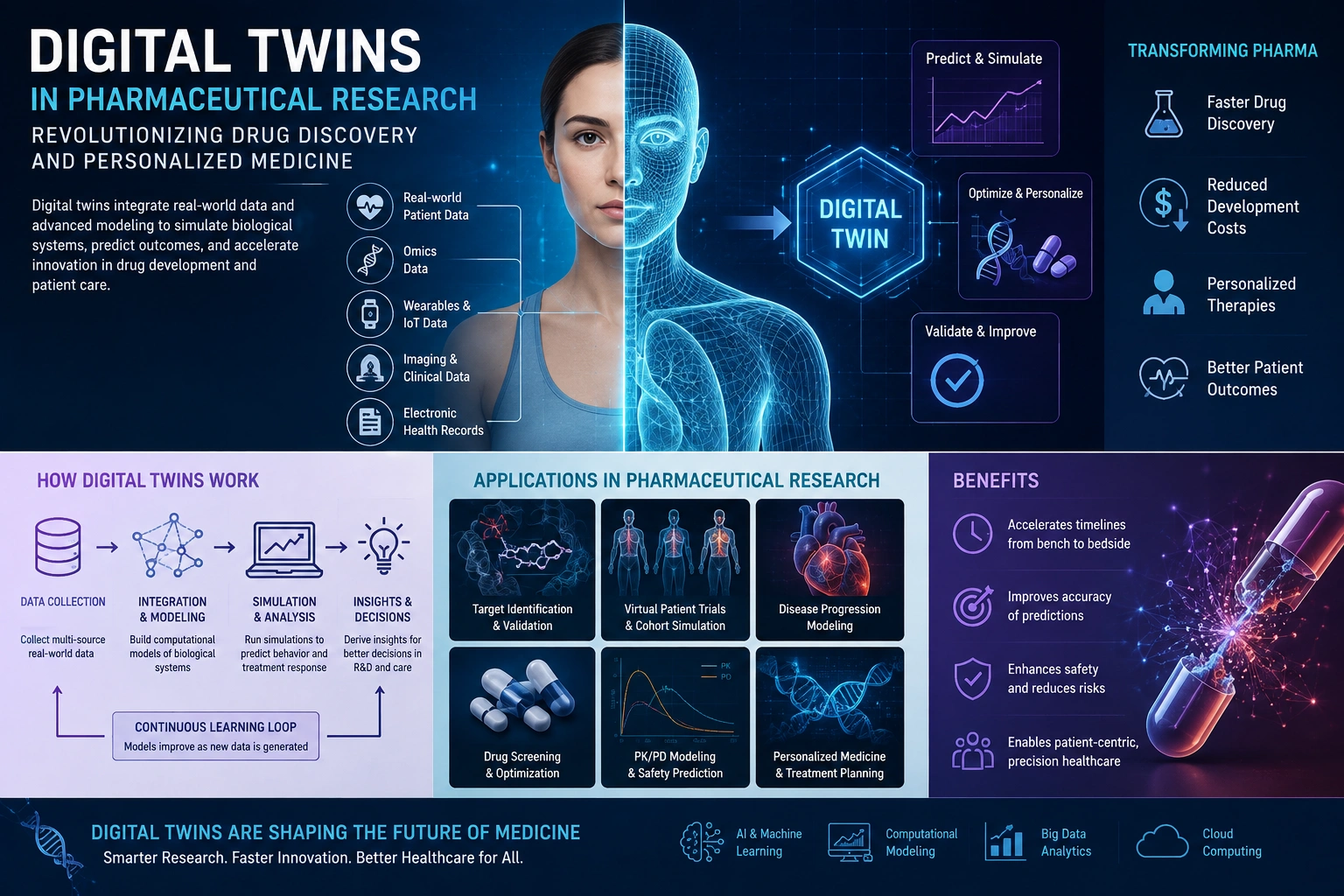
The pharmaceutical industry is undergoing a digital transformation driven by artificial intelligence (AI), machine learning (ML), big data, and advanced computational modeling. Among these innovations, Digital Twin (DT) technology has emerged as a promising tool capable of transforming pharmaceutical research, drug development, clinical trials, and personalized medicine.
A digital twin is a virtual replica of a physical object, biological system, process, or patient that continuously updates itself using real-world data. Originally developed for aerospace and manufacturing industries, digital twins are now gaining significant attention in healthcare and pharmaceutical sciences for their ability to predict outcomes, optimize drug development, and reduce research costs.
A digital twin is a dynamic virtual model that accurately represents a physical entity throughout its lifecycle. In pharmaceutical research, digital twins can simulate:
Unlike traditional computer models, digital twins are continuously updated using real-time data collected from laboratory experiments, wearable devices, imaging systems, electronic health records (EHRs), and genomic databases.
The development of a pharmaceutical digital twin involves several interconnected steps:
AI algorithms combine these diverse datasets into a unified computational model.
The digital twin simulates physiological processes, disease progression, and drug responses under different scenarios.
Researchers can evaluate treatment outcomes, optimize drug doses, predict adverse effects, and refine therapeutic strategies before applying them in real-world settings.
Digital twins allow researchers to simulate how potential drug candidates interact with biological targets before laboratory testing. This approach helps prioritize promising compounds, reducing the time and resources required for drug discovery.
Benefits:
Animal experiments are often expensive, time-consuming, and associated with ethical concerns. Digital twins can simulate biological responses, allowing researchers to evaluate drug behavior virtually before conducting in vivo studies.
This supports the 3Rs principle:
Clinical trials frequently encounter challenges such as patient recruitment, variable treatment responses, and high failure rates.
Digital twins can create virtual patient populations that closely mimic real participants, enabling researchers to:
As a result, clinical trials become more efficient and cost-effective.
Every patient responds differently to medications due to genetic, metabolic, and environmental factors.
Patient-specific digital twins integrate individual health data to predict:
This supports precision medicine by enabling tailored treatment plans that maximize efficacy and minimize toxicity.
One of the major reasons for drug failure is unexpected toxicity.
Digital twins can simulate:
This helps identify potential safety issues early, reducing costly failures during later stages of development.
Digital twins are increasingly used to optimize manufacturing processes by monitoring:
Real-time monitoring improves productivity while minimizing manufacturing errors and downtime.
Artificial Intelligence serves as the foundation of digital twin technology by enabling:
Machine learning algorithms analyze vast datasets and improve the accuracy of digital twins as more data become available.
Digital twin technology offers several advantages for pharmaceutical research:
Despite their enormous potential, digital twins face several challenges:
Developing accurate digital twins requires large volumes of high-quality clinical, genomic, and experimental data.
Protecting sensitive patient information remains a major concern, requiring strict compliance with data protection regulations.
Building realistic digital twins demands advanced computational infrastructure, high-performance computing, and sophisticated algorithms.
Virtual predictions must be validated through laboratory experiments and clinical studies before they can be widely adopted.
Clear regulatory frameworks are still evolving for the use of digital twins in pharmaceutical development and healthcare.
The future of digital twins in pharmaceutical research is highly promising. Advances in artificial intelligence, cloud computing, wearable technologies, multi-omics integration, and
high-performance computing are expected to make digital twins increasingly accurate and clinically relevant.
Future applications may include:
As these technologies mature, digital twins are expected to become a cornerstone of next-generation pharmaceutical research and precision healthcare.
Digital twin technology represents a significant advancement in pharmaceutical research by integrating artificial intelligence, computational modeling, and real-world data to create dynamic virtual representations of patients, biological systems, and manufacturing processes. Its applications in drug discovery, toxicity prediction, clinical trials, and personalized medicine have the potential to improve efficiency, reduce development costs, and enhance patient outcomes. While challenges related to data quality, validation, and regulatory acceptance remain, continued technological progress is expected to drive widespread adoption of digital twins, paving the way for a more predictive, personalized, and efficient future in pharmaceutical sciences.