

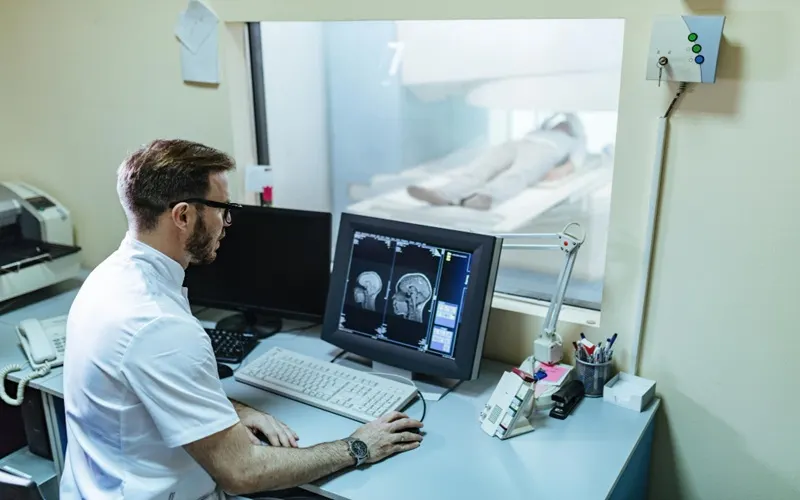
Have you ever questioned the fact that what exactly helps doctors to see what the naked eye can’t? Well, there lies a precision and skill set of a radiologist behind every diagnosis. It’s a professional who is specialised in using imaging technology to discover the truths that lie inside the human body. If you’re even slightly fascinated by the blend of science and wish to explore the technology and healthcare sector more, pursuing a Radiology and Imaging Technology course could possibly be your gateway to an exciting and meaningful career.
This field is not just about operating machines, but more like interpreting images that turn out to be helpful in saving lives, improving treatments and shaping the future of medical vision. You will see more X-rays, CT scans, MRIs and ultrasounds in detail as a radiologist, who has a crucial role in detecting and preventing diseases. In this blog, we will explore how to become a radiologist and the importance that this degree has, along with how it can open the door to a future driven by innovation and care.
Radiology and Imaging Technology is related to the field of medicine that uses special imaging tools that are enabled to visualise the insides of the human body. It comes with both the technical operation of imaging equipment and the interpretation of images, which has the responsibility of helping doctors in diagnosis and treatment planning.
This discipline brings physics, biology and medical technology together to produce precise images that are then used to reveal what’s happening inside the body. It ranges from detecting a fracture to spotting a tumour to examining organs. Radiology offers a clear picture of conditions that otherwise remain invisible.
Students studying Radiology and Imaging Technology learn the basics to advanced techniques of how to operate imaging equipment like X-rays, MRI, CT, PET scans and ultrasounds. Along with that, they also develop a deeper understanding of the areas like anatomy, pathology, radiation safety and image interpretation that are all essential for working effectively in a clinical environment.
A medical expert who is specialised in using advanced imaging tools to make sure everything inside the human body is functioning well. Their job is to help doctors understand what’s happening inside the body without surgery. Simply put, they’re the ones who help “see the unseen” and find clues that are then used to derive an accurate diagnosis and treatment.
To understand it in simple terms, a radiologist is someone who reviews scan reports to detect any issue in the body, like broken bones, tumours, infections or any other problem that could be fatal for the patient. Their job includes interpreting these images and sharing what they find with doctors to plan the right treatment. Some also have other tasks to perform, like image-guided procedures, such as inserting stents or taking tissue samples. Their expertise makes sure that patients get the right care based on the right information.
Radiology is not an enclosed field. There are different types of radiologists based on their area of specialisation-
Are supposed to analyse medical images to detect any cause of diseases or injuries.
Use imaging techniques to guide minimally invasive procedures- biopsies or angioplasty are examples.
Mostly focus their career on treating cancer using radiation therapy.
Are specialised in diagnosing illnesses that affect children using specific imaging technology.
Deal with imaging related to the CNS or the brain, spine and nervous system.
Each type has a key role to play in patient care, where they work together to make modern medicine more accurate and efficient.
Radiology covers a wide range of specialities which cover each human body section and where each of them focuses on some specific parts of the body or types of imaging. Some radiologists have an option to specialise in-
Which is focused on diagnosing lung and heart conditions using different machines and methods like X-rays, CT scans and MRIs.
Specifically deals with the structure of our body that includes bones, joints and soft tissues and also often contributes to sports injury diagnosis.
Specialises in imaging internal organs like the liver, kidneys, stomach and intestines.
Involves mammography and related techniques used to detect any early signs of breast cancer.
Provides quick imaging assessments for trauma or critical patients in emergency settings.
These specialities are designed so as to allow radiologists to hone their skills in something specific and work closely with other medical professionals in their chosen domain.
Yes, radiologists are doctors. They complete their medical schooling, which is followed by any specialised training in radiology. Their journey involves learning about both the medicine and the respective technology. Their job is to understand how diseases affect the body and how to detect them through imaging. Although the work they do might not include performing any surgeries or even doing regular check-ups, they still have an important role in diagnosing and treating patients.
| Serial No. | Aspect | Radiologist | Radiologic Technologist |
| 1. | Qualification | A medical doctor with MBBS + MD or equivalent, specialising in radiology | Holds a BSc in Radiology and Imaging Technology or a related diploma |
| 2. | Role | Has to interpret medical images, diagnose diseases and collaborate with doctors on treatment plans. | Operates imaging machines- X-ray, CT and MRI scanners- and captures clear diagnostic images. |
| 3. | Work Focus | Focuses on analysing and reporting results based on images | Focuses on image acquisition and ensuring patient comfort during procedures |
| 4. | Training Duration | Around 8 – 10 years | Typically 3 – 4 years for a bachelor’s degree |
| 5. | Decision-Making Power | Makes diagnostic decisions and provides medical opinions | Provides technical assistance and follows radiologist instructions |
| 6. | Work Environment | Hospitals
Research centres Private clinics Universities |
Hospitals
Diagnostic centres Imaging labs |
| 7. | Salary Range | ₹12 – 25 LPA | depending on experience and expertise | ₹3 – 8 LPA | based on skills, location and experience |
Becoming a radiologist surely takes some time, patience and dedication throughout. And since it’s a medical speciality, you can expect the journey to be longer than most healthcare roles that exist. Typically, if you’re thinking to become a radiologist, it goes like this-
You begin by earning an MBBS degree after 5.5 years, which includes both academic study followed by an internship.
After MBBS, you pursue an MD or DNB that lasts 3 years in Radiology to gain expertise.
Some radiologists choose to go further into subspecialties for 1 – 2 years, which can be neuroradiology or interventional radiology.
In total, it can take you around 8 – 10 years to become a well-qualified radiologist in India. The path is long, but the rewards are equally fulfilling.
If you look at it from the perspective of an educational and professional journey, it starts by building a solid foundation in science. While doing a course in Radiology and Imaging Technology is an excellent starting point, advancing into radiology as a medical doctor requires further study.
Have a look at the path you must follow to become a radiologist:
Your first step to become a radiologist begins in school — you must complete your +2 with Physics, Chemistry and Biology as core subjects. A good score here opens doors to reputed universities offering radiology courses.
This undergraduate course will introduce you to some deep topics like imaging systems, anatomy and patient care. You’ll learn everything about X-rays, CT scans and MRI technology through classroom teaching and practical clinical sessions.
During or after your BSc, internships or hospital training expose you to real-life imaging scenarios — understanding patient positioning, image interpretation and machine calibration.
To become a certified Radiologist or an MD in Radiology, you’ll have to pursue MBBS, followed by “MD/DNB in Radiology”.
You may need to register with relevant medical councils or even have to obtain certification in radiation safety and imaging standards.
Radiology is a part of medical science that offers great growth potential for your career because of its rapid growth. The profession combines advanced technology with healthcare, hence impacting the results in this field.
A few compelling reasons why you should become a radiologist-
This field evolves constantly with AI-based diagnostic tools to 3D imaging, allowing professionals to stay ahead in innovation.
Radiologists and imaging professionals contribute a major part to modern medicine. Thus, no accurate diagnosis or treatment plan can be made without medical imaging.
Graduates can work in hospitals, diagnostic centres, research labs and even medical equipment companies.
Radiology skills are in demand globally as they offer career mobility and equal opportunities for international exposure.
Radiology as a field requires you to master a mixture of skills like technical precision, analytical ability and equal patient care. Professionals must know how to take care of complex imaging systems while also ensuring safety and accuracy equally.
A few key skills required to become a radiologist include-
If you’re planning to become a radiologist, you have some of the clearest academic routes you can take. Starting from comprehensive undergraduate programmes to short-term diplomas and certificates. Look at the breakdown of the most common options available in India to become a radiologist-
This 4 year undergraduate programme is one of the most chosen courses after completing +2. It blends theoretical learning and on ground training with diagnostic imaging, radiation physics, anatomy, physiology and pathology.
It focuses more specifically on radiographic imaging and patient positioning. This course trains students to operate diagnostic equipment and interpret medical images under proper supervision. It’s very ideal for those who want a deeper exposure to clinical radiography.
If you wish to start working sooner, a diploma programme is a great option. Typically lasting 1–2 years, it concentrates on practical and operational aspects — handling imaging equipment, ensuring patient safety and understanding basic diagnostics.
Short-term certification courses (lasting a few months to a year) are suitable for upskilling or entering the profession at an assistant level. They’re also a good choice for professionals looking to add specific imaging skills to their existing medical background.
A Bachelor of Science in Radiology and Imaging Technology is an undergraduate programme that spans 4 years. It basically teaches students the basics and know-how of how diagnostic imaging works and its practical uses. The course covers major topics like physics, anatomy and medical technology that help students learn how to generate and study accurate diagnoses using imaging.
This course is not just for training you to take medical images, but also teaches you to understand what those images represent. Students gain insight into how diseases manifest visually, learn about safe radiation practices and become skilled in handling sophisticated imaging systems used in hospitals and diagnostic centres.
| Serial No. | Particulars | Details |
| 1. | Course Name | BSc in Radiology and Imaging Technology |
| 2. | Duration | 4 years |
| 3. | Eligibility | Science stream in your 10+2 from a recognised board. |
| 4. | Core Subjects | Human Anatomy
Radiation Physics Radiographic Techniques Medical Imaging Radiation Safety MRI CT Principles |
| 5. | Mode of Study | Full-time |
| 6. | Career Pathways | MRI Technician
Radiologic Technologist Diagnostic Imaging Specialist |
The syllabus for a BSc in Radiology and Imaging Technology is designed such that it balances theory, practical knowledge and clinical exposure on the same level. Students get to learn about various imaging techniques and subjects like radiation physics, anatomy as well as patient care.
A few common subjects you have to study to become a radiologist include-
In the later semesters, students get to practice in clinical postings and take part in project work to apply theoretical learning with real-world imaging settings.
A BSc in Radiology and Imaging Technology opens a multitude of pathways for you as various career options across the healthcare sector. Graduates are then allowed to work in clinical environments, diagnostic centres, research institutions and radiology equipment firms.
A few top career roles in this profession are-
Many students also choose to pursue higher education such as MSc in Radiology and Imaging Technology or MRT for career advancement and research opportunities.
| Serial No. | Experience Level | Approx. Annual Salary | Role Examples |
| 1. | Entry-Level | ₹3 – ₹6 LPA | Radiology Technician
X-ray Operator Junior Imaging Assistant |
| 2. | Mid-Level | ₹6 – ₹10 LPA | MRI Technician
Diagnostic Imaging Specialist Sr. Radiographer |
| 3. | Senior-Level | ₹10 – ₹15 LPA or more | Radiology Department Head
Imaging Consultant Interventional Imaging Expert |
Graduates of BSc Radiology and Imaging Technology can find opportunities in a range of healthcare organisations. The growing number of diagnostic centres and hospitals ensures steady employment prospects.
Top recruiters include-
If you’re looking to step into the world of medical imaging and radiology with a degree that goes beyond textbooks, The Apollo University, with its B.Sc. Imaging Technology programme, is known for offering a launchpad that can help you achieve that. Here’s why the university stands out, especially for those who wish to become the guardians of medical vision.
Backed by a Trusted Healthcare Brand
Globally recognised Apollo Hospitals Group, lending strong industry credibility and aligning education with good healthcare standards.
Immersive Curriculum
Advanced imaging techniques, radiographic photography, image processing and the physics of radiology ensure graduates are not just academically ready but also for what lies in the future.
Early Patient Contact and Practical Training
From early patient interactions to simulation-based training, the programme ensures you are comfortable in practical settings, not just in theory.
Enhanced Learning Environment
Offers modern digital learning tools and simulation labs that can replicate real-life imaging scenarios, which ultimately boosts your professional development right from your starting years.
Scholarships and Flexible Admission Options
There are scholarship opportunities for eligible students and also a structured admission process that makes the journey even smoother.
Clear Career Pathways
On completion, you’ll be equipped to work as a CT scan technician, MRI technician, X-ray technician or radiology technician roles which are in growing demand.
If you’re ready to shape the future of medical vision and want to make an impact in the world of healthcare, The Apollo University’s B.Sc. Imaging Technology is your way to accomplish that. Take the first step today!
Radiology is more like the art and science of seeing beyond the surface. As a radiology professional, you utilise the technology for healing patients and helping doctors make life-saving decisions every single day.
Pursuing a BSc in Radiology and Imaging Technology is not just about learning how to use machines; it’s about developing the vision to see what others can’t and the compassion to use that knowledge for the betterment of society.
So, if you’re ready to shape the future of medical vision, this path might just be your perfect start. Apply now!
This is a 4-year undergraduate programme that teaches you how diagnostic imaging works and how to operate imaging equipment (X-ray, CT, MRI, ultrasound) while also understanding anatomy, pathology, radiation safety and image interpretation.
You’ll study Human Anatomy & Physiology, Radiographic Techniques, Radiation Physics & Instrumentation, Medical Imaging (CT, MRI, Ultrasound), Pathology & Microbiology, Radiation Safety & Quality Assurance and Patient Care.
Generally you must have completed 10+2 (or equivalent) in the Science stream with Physics, Chemistry, Biology (PCB). Some colleges require a minimum aggregate of 50%.
The duration of BSc Radiology & Imaging Technology programme is 4 years.
Yes — after this degree you can work as a Radiologic Technologist, CT or MRI Technician, Diagnostic Imaging Specialist, in hospitals, diagnostic centres, equipment firms or even opt for research. If you are interested in imaging technology + healthcare, it is a promising path.