

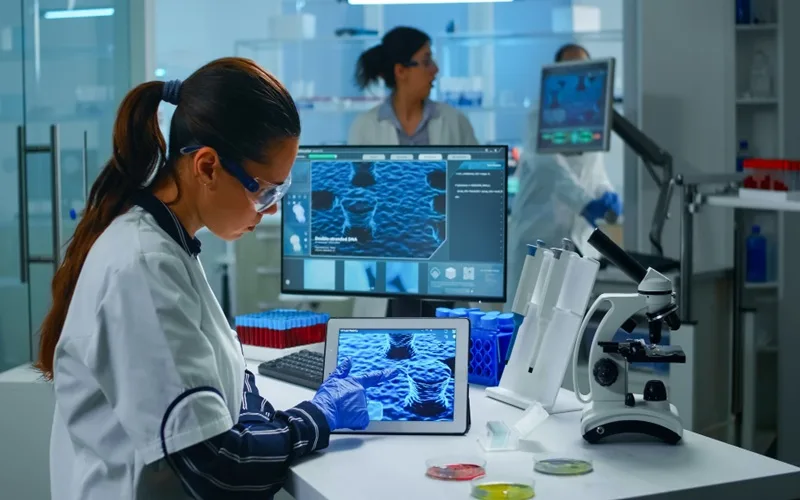
Biotechnology is one of the most rapidly evolving branches of science, blending biology with technology to create innovative solutions that improve healthcare, agriculture, environmental conservation and industrial production. From developing vaccines and genetically modified crops to producing biofuels and pharmaceuticals, biotechnology impacts nearly every aspect of modern life.
A Bachelor of Science in Biotechnology (BSc Biotechnology) introduces students to the molecular mechanisms of life and how they can be manipulated for practical use. Through a blend of classroom learning and intensive laboratory sessions, the course prepares graduates for careers in research, medicine, agriculture, food technology and bioprocessing industries.
If you are a science student passionate about exploring genetics, cell biology and molecular processes, this course offers the perfect foundation to begin a career in the life sciences. Let’s dig deeper into the BSc Biotechnology syllabus and other details.
| Serial No. | Particulars | Details |
| 1. | Course Name | Bachelor of Science (BSc) in Biotechnology |
| 2. | Course Type | Undergraduate Degree |
| 3. | Duration | 4 years (8 semesters) |
| 4. | Eligibility Criteria | 10+2 with Physics, Chemistry and Biology (minimum 50% marks) |
| 5. | Admission Process | Merit-based or through entrance exams like CUET, IISER or state-level CETs |
| 6. | Average Annual Fee | ₹50,000 – ₹2,00,000 (varies by institution) |
| 7. | Average Starting Salary | ₹3 – ₹5 LPA |
| 8. | Top Recruiters | Biocon, Dr Reddy’s Laboratories, Bharat Biotech, Serum Institute of India, CSIR, ICMR |
| 9. | Higher Studies Options | M.Sc Biotechnology, M.Tech Biotechnology, MBA in Biotechnology Management |
BSc Biotechnology is a four-year undergraduate degree that focuses on the scientific study of living organisms and their technological applications in various fields. It integrates biology, chemistry, physics and information technology to develop products and processes beneficial to humanity.
The curriculum introduces students to core concepts such as cell biology, molecular genetics, microbiology, biochemistry, bioinformatics and bioprocess engineering. Apart from theoretical learning, students engage in hands-on laboratory training, research projects and industrial internships to gain practical experience.
Graduates develop strong analytical and problem-solving skills, enabling them to contribute to sectors such as pharmaceuticals, agriculture, healthcare, food processing and environmental management.
Choosing to study BSc Biotechnology is ideal for students seeking to explore life sciences beyond the classroom and engage in real-world problem-solving through research and innovation. Here’s why this programme is one of the most promising in today’s world:
The BSc Biotechnology syllabus is carefully designed to balance theory, laboratory work and research exposure. The course gradually transitions from understanding biological fundamentals to mastering applied biotechnology tools.
Below is a detailed semester-wise breakdown of the BSc Biotechnology syllabus:
The first year focuses on developing a strong understanding of the biological and chemical principles that underpin biotechnology.
In the second year, students move towards understanding how molecular mechanisms control life processes and how these can be applied technologically.
The final year prepares students for real-world research and industrial applications. Students also work on individual or group projects that demonstrate their understanding of core and applied concepts.
The final year BSc Biotechnology syllabus is designed to consolidate theoretical knowledge and apply it through research, innovation and independent learning. It focuses on developing a strong foundation for higher studies or professional roles in biotechnology and related domains.
This final phase of the course empowers students to bridge academia and industry, gaining both technical expertise and research proficiency.
| Serial No. | Semester | Core Subjects |
| 1. | Semester I | Cell Biology, Chemistry, Microbiology, Biostatistics, Laboratory Techniques |
| 2. | Semester II | Biomolecules, Biophysics, Environmental Science, Instrumentation |
| 3. | Semester III | Molecular Biology, Genetics, Enzymology, Immunology |
| 4. | Semester IV | Plant Biotechnology, Animal Biotechnology, Environmental Biotechnology |
| 5. | Semester V | Genetic Engineering, Bioprocess Engineering, Bioinformatics |
| 6. | Semester VI | Medical Biotechnology, Industrial Biotechnology, Project/Dissertation |
In the later semesters, students can choose electives or pursue specialisations that align with their career aspirations. These electives provide an opportunity to explore niche areas of biotechnology.
Common Electives:
Specialisations Offered by Some Universities:
The fee structure for BSc Biotechnology in India varies depending on the institution’s reputation, facilities and mode of study (regular, distance or online). Government colleges usually offer the course at a subsidised rate, while private and autonomous universities may have higher tuition due to advanced laboratories, research facilities and internship provisions.
| Serial No. | Type of Institution | Average Annual Fee Range (₹) | Remarks |
| 1. | Government Colleges | ₹20,000 – ₹60,000 | Lower fees due to government funding and subsidies. |
| 2. | Private Universities | ₹2,00,000 – ₹5,00,000 | Includes lab charges, project expenses and internship support. |
| 3. | Deemed/Autonomous Institutions | ₹1,50,000 – ₹3,00,000 | Often provide international exposure and research mentorship. |
| 4. | Distance or Online Programmes | ₹25,000 – ₹70,000 | Suitable for working professionals or those preferring flexible study schedules. |
It’s worth noting that some universities also include industry immersion modules and laboratory skill certifications, which might affect the total cost but provide excellent practical value.
A degree in BSc Biotechnology opens the door to numerous scientific and industrial career paths. Graduates are trained to combine analytical and experimental knowledge, making them suitable for both research-based and production-oriented roles.
| Serial No. | Job Role | Description | Average Salary (₹ per annum) |
| 1. | Biotechnologist | Research and develop biological solutions in healthcare, agriculture and industry. | 4 – 6 LPA |
| 2. | Research Associate | Conduct experiments, collect data and assist in scientific publications. | 3 – 5 LPA |
| 3. | Quality Control Analyst | Test and ensure the quality of biopharmaceutical and food products. | 3 – 4.5 LPA |
| 4. | Clinical Research Assistant | Support clinical trials and analyse results for drug efficacy. | 3 – 5 LPA |
| 5. | Bioprocess Engineer | Design and optimise industrial-scale bioprocesses. | 5 – 8 LPA |
| 6. | Bioinformatics Analyst | Work with biological databases and computational models. | 4 – 6 LPA |
Graduates can appear for competitive exams like CSIR-NET, GATE or ICMR-JRF to enter national research institutions such as:
Many students pursue postgraduate degrees like:
These programmes open doors to teaching, specialised research and international career prospects.
Admission into BSc Biotechnology programmes across India is conducted through either merit-based selection or entrance exams. Some of the most recognised entrance tests include:
| Serial No. | Exam Name | Conducting Body | Eligibility | Mode | Frequency |
| 1. | CUET (UG) | National Testing Agency (NTA) | Candidates who have completed 10+2 with Physics, Chemistry and Biology from a recognised board | Online | Annual |
| 2. | IISER Aptitude Test (IAT) | Indian Institutes of Science Education and Research (IISERs) | 10+2 with Science stream (must have studied Biology, Physics and Chemistry) | Online | Annual |
| 3. | NEET-UG | National Testing Agency (NTA) | 10+2 with PCB; some universities accept NEET scores for admission to Biotechnology programmes | Offline (OMR-based) | Annual |
| 4. | All India Entrance Examination for Admission (AIEEA – UG) | Indian Council of Agricultural Research (ICAR) | 10+2 with Physics, Chemistry, Biology/Mathematics/Agriculture | Online | Annual |
Each exam evaluates students’ understanding of Physics, Chemistry and Biology, with some including aptitude-based sections. Students should also check for university-level entrance tests, as many private universities have their own selection criteria.
At The Apollo University, the B.Sc. Biotechnology (Honours) programme is designed for ambitious students who wish to shape the future of health, agriculture and environmental sciences. The curriculum integrates biology, chemistry and computational sciences to equip graduates with conceptual knowledge, technical expertise and a research-oriented mindset.
Here are the key highlights of WHY students choose this programme:
You will study core life-science subjects and also gain exposure to high-end technologies such as genomics, proteomics and CRISPR. The programme emphasises hands-on laboratory sessions, internships and project-based learning.
The university has active collaborations with industry leaders like Dr. Reddy’s Institute of Life Sciences (DRILS), Aurobindo Pharma and also global academic tie-ups with Harvard Medical School and Monash University. Such partnerships enrich training, research and innovation for students.
Beyond standard lectures, you’ll engage in hypothesis-driven research, critical data analysis and interdisciplinary tasks that bridge bioinformatics, systems biology and omics technologies.
From laboratory proficiency to an innovation mindset, the programme develops a broad skill set, including ethical responsibility, critical thinking and communication, all essential for career success in biotechnology.
If you’re keen to pursue a future at the cutting edge of biotechnology — where science meets real-world impact — this is the programme for you. Apply now and launch your journey into the next generation of life-science innovation!
The BSc Biotechnology syllabus is designed to create a seamless blend of theoretical knowledge and practical research experience. By the end of the course, students are capable of applying biological concepts to solve real-world problems in healthcare, agriculture and environmental conservation.
With biotechnology shaping the future of medicine and sustainability, pursuing this degree can position you at the forefront of scientific innovation. From working in research laboratories and biotech firms to pursuing higher education in advanced specialisations, the possibilities are limitless for motivated learners.
Core subjects include Cell Biology, Molecular Biology, Genetics, Microbiology, Biochemistry, Bioinformatics and Genetic Engineering.
You need analytical thinking, laboratory precision, problem-solving skills and a keen interest in molecular biology and data interpretation.
Yes. Most universities only require Physics, Chemistry and Biology at the 10+2 level. However, basic mathematical concepts are taught as part of biostatistics.
Some leading employers include Biocon, Serum Institute of India, Dr Reddy’s Laboratories, Bharat Biotech, Panacea Biotech and research organisations like CSIR and ICMR.
Absolutely. With advancements in genetics, molecular research and healthcare innovation, biotechnology graduates are in high demand across public and private sectors globally.